Presented at SALT 2025.
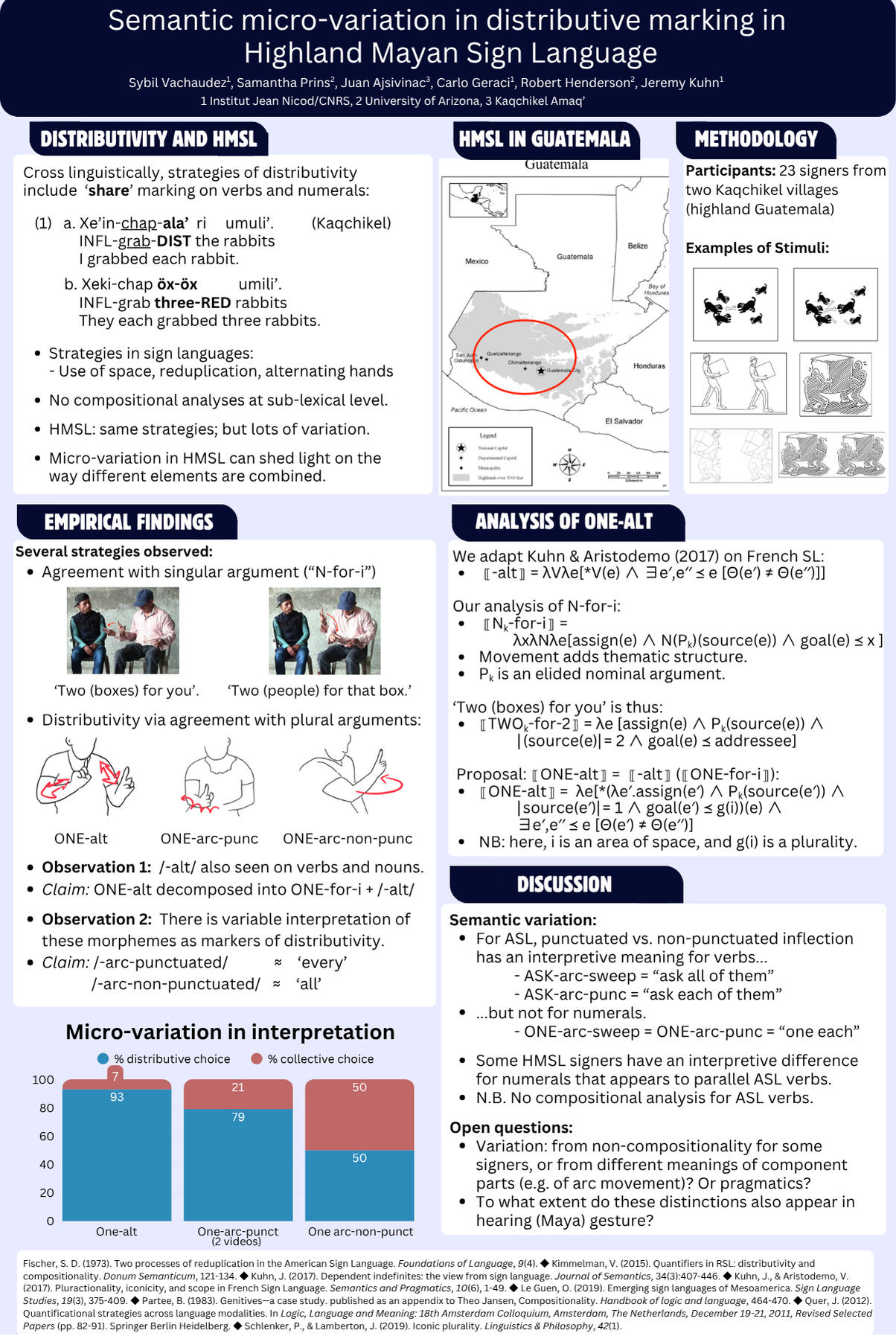
There are a large number of small sign languages throughout Maya-speaking regions of Mesoamerica due to high rates of congenital deafness in various Maya communities (Le Guen 2019). These communities have only been studied from an anthropological perspective, with no formal description of the grammatical properties of their languages. Mesoamerican languages, and Mayan languages in particular, have been shown to have rich morphological systems of distributivity (Henderson 2014). In this presentation, given the contact between Mesoamerican sign languages and the Mayan languages used by the surrounding hearing community, we describe results on distributive marking in Highland Mayan Sign Language (HMSL), an essentially undocumented language group from highland Guatemala. We uncovered several strategies for the marking of distributivity. Our findings are that (a) these strategies are attested in other, better studied, sign languages (American Sign Language: Fischer 1973, Kuhn 2017; Catalan Sign Language: Quer 2012; Russian Sign Language: Kimmelman 2015), and (b) that the distribution of judgments across strategies, as well as the particular structure of micro-variation suggest that one strategy, namely non-punctuated marking, is less stable.